⏱️ Reading time: 6 min
What is language development? It is the extraordinary process by which babies and young children learn to communicate, understand, and interact with the world around them. Initially, this process may seem like simple babbling, but it is the foundation upon which relationships, learning, and the very structure of thought will be built. Closely monitoring the milestones of language development is not just about ensuring a child speaks early, but about ensuring their communication skills are developing healthily, opening doors to a secure childhood and a successful social and academic life. Understanding this guide is essential for parents, caregivers, and educators.
🧭 This content is part of our series on Youth, School, and Social Media: A Guide to Mental Health in the Screen Age. 👈 (click here)
Nurturing the young mind is sowing the seeds for a future where mental health flourishes from an early age.
The First Sounds: From Crying to First Words
Initially, crying is a baby’s first and most vital form of communication. It signals hunger, discomfort, or the simple need to be held. Quickly, around 2 to 4 months, guttural sounds give way to charming coos and social smiles. By 6 months, the babbling stage emerges, with repetitive syllables like “ba-ba-ba” and “da-da-da”. It is crucial muscle and neural training. Mainly, it is between 9 and 12 months that the magic happens: babbling begins to imitate the intonation of adult speech, and the child may begin to understand simple commands and express their first intentional words, like “mama” or “dada”. Each child has their own pace, but the progression of this sequence is universally fascinating.
The Vocabulary Explosion and Sentence Formation
Between 1 and 2 years of age, what experts call the “vocabulary explosion” occurs. The child, who perhaps knew a few words, starts learning new ones every day, expanding their repertoire rapidly. Furthermore, they begin to combine words, forming their first telegraphic phrases, like “want water” or “where ball”. Initially, these phrases are economical, containing only the most meaning-laden words. However, around 2 years old, the child is already capable of forming simple sentences with two to four words, beginning to master basic grammar concepts. This is a period of intense discovery, where language becomes the primary tool for exploring the world.
Red Flags: When to Seek Specialized Help
Understand child development milestones
Although each child develops at their own pace, there are some red flags that deserve attention and may indicate the need for an evaluation with a speech-language pathologist or a developmental pediatrician. Recognizing these signs early is one of the most powerful ways to support a child.
- Absence of babbling or gestures (like pointing or waving goodbye) by 12 months.
- Not speaking simple words by 16 months.
- Not producing spontaneous two-word phrases by 2 years.
- Persistent difficulty understanding simple commands.
- Loss of language skills the child previously had.
- Absence of pretend play or imitation.
The presence of one or more of these signs is not a diagnosis, but an invitation to investigate. Early intervention is the key to overcoming challenges and enhancing development. For broader behavioral questions, understand child development milestones holistically.
Factors Influencing Language Development
The development of speech and language does not occur in a vacuum. It is profoundly shaped by a combination of factors. The biological and genetic factor sets the potential, but it is the environment that will nurture and shape this potential. Social interaction is the main engine. Children immersed in a rich linguistic environment, where adults read, sing, talk, and describe the world around them, have constant and powerful stimulation. The quality of interactions, with sensitive and attentive responses to the baby’s sounds and gestures, is as important as the quantity. Other factors, such as preserved hearing and general health, are the physical foundation that supports the entire process.
Practical Strategies to Stimulate Speech at Home
Strategies to stimulate speech
Recommended Readings

Adult ADHD: Taming the Restless Mind
Adult ADHD. Learn to identify the signs, tame mental restlessness, and adopt practical strategies to regain focus and organization.

What Is Mental Health? Beyond the Absence of Diseases
Discover what mental health is beyond the absence of illness. Learn about the pillars of well-being and strategies to cultivate balance.

Impostor Syndrome: The Internal Fraud That Persists
Understand the psychological roots of impostor syndrome, its manifestation beyond work, and how self-compassion can be the antidote.
Stimulating language development does not require expensive materials or complex techniques. The best strategies are simple, affectionate, and can be perfectly integrated into the family routine. The key is intentional and pleasurable interaction.
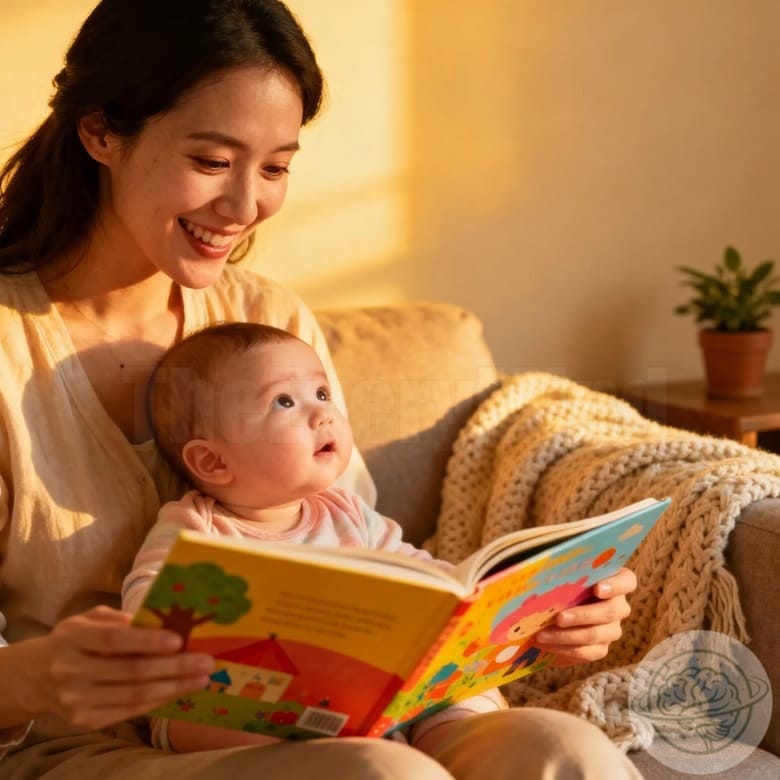
- Read Aloud Every Day: Reading children’s books is one of the most complete stimuli. It exposes the child to a rich and diverse vocabulary, introduces narrative structure, and strengthens bonding.
- Narrate the Routine: Describe what you are doing while dressing, feeding, or bathing the baby. Phrases like “Now we’re putting on the red shirt” turn daily activities into language lessons.
- Sing and Play with Songs: Nursery rhymes and games with gestures, like “The Little Chickens” or “Head, Shoulders, Knees and Toes,” associate words with actions, making learning playful and memorable.
- Expand the Child’s Phrases: If they say “car,” you can respond: “Yes, that’s a big blue car!”. You validate their speech and enrich it with new concepts.
These strategies to stimulate speech are powerful tools for creating a linguistically nurturing environment. Furthermore, it is crucial to be a patient and interested listener, giving the child the time and security they need to express themselves.
Practical Exercise: Baby Conversation Time
This exercise promotes “turn-taking conversation,” the basis of communication development.
- Context: Choose a quiet moment, with the baby alert and receptive.
- Sound Imitation: When the baby makes a sound (“ga-ga”), wait for them to finish and repeat the sound exactly, with the same intonation (“ga-ga”).
- Wait for a Response: Look at them with expectation, giving them time to make another sound.
- Add a New Sound: After a few exchanges, introduce a new simple sound (“ba-ba”) and wait to see if they try to imitate it.
- Duration: Practice for 2 to 5 minutes, a few times a day.
This communicative “dance” teaches the baby the fundamentals of a conversation: listening, waiting their turn, and responding. It is a powerful way to demonstrate that their sounds have meaning and value.
After learning about these strategies, what simple moment in your routine with your child do you believe could become the next, more meaningful “language lesson”? Tell us in the comments!
To delve deeper, check these references:
- Brazilian Society of Pediatrics (SBP). (2022). Guidance Guide: Child Development. Comprehensive document with developmental milestones, including language and red flags.
- American Speech-Language-Hearing Association (ASHA). (2023). Activities to Encourage Speech and Language Development. Compilation of practical, evidence-based strategies for parents and caregivers.
- Tomasello, M. (2003). Constructing a Language: A Usage-Based Theory of Language Acquisition. Reference work exploring the usage-based theory of language and the importance of social interaction in acquisition.
The pressure on children and adolescents is multifaceted. Better understand this ecosystem in our central guide: Youth, School, and Social Media: A Guide to Mental Health in the Screen Age.