⏱️ Reading time: 5 min
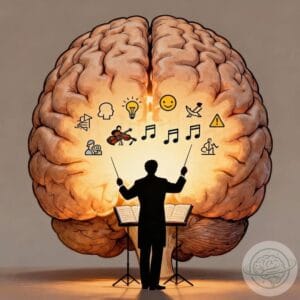
Creative process in the brain is a complex phenomenon that goes far beyond isolated moments of inspiration. It is a sophisticated neural dance involving multiple brain regions working in synchrony to generate new ideas and solutions. The neuroscience of creativity has revealed that innovation is not a mysterious gift, but rather a brain capacity that can be understood and cultivated. Understanding the creative process in the brain allows us to demystify the genesis of great ideas and develop strategies to enhance our inventive capacity in various areas of life.
The neural networks of creativity
The neuroscience of creativity identifies three main brain networks that interact during the creative process in the brain. The Default Mode Network, traditionally associated with daydreaming and imagination, is activated when we let our mind wander freely, allowing unusual associations between seemingly disconnected concepts. The Executive Control Network comes into play when we need to evaluate, refine, and implement these ideas, bringing focus and direction to the process. Finally, the Salience Network acts as a switch, alternating between these two networks as needed. This tripartite dynamic reveals that creativity involves both free thinking and critical evaluation.
The neurobiological stages of creation
The creative process in the brain follows distinct stages with specific neural signatures. Preparation involves intense focus and activation of networks related to prior knowledge about the problem. Incubation follows, where the Default Mode Network becomes predominant while we engage in activities unrelated to the problem, allowing unconscious processing. The insight or “eureka” moment correlates with a burst of activity in the right anterior temporal lobe, preceded by a peak in alpha waves that inhibits distracting stimuli. Finally, verification and elaboration recruit the executive control again to test and refine the generated idea. This understanding from the neuroscience of creativity shows us that moments of leisure can be as productive as periods of intense focus.
Neurotransmitters and creativity
Brain chemistry plays a crucial role in the creative process in the brain. Dopamine, associated with motivation and reward, favors the exploration of new possibilities and persistence in the face of challenges. Norepinephrine modulates alertness, finding its ideal point for creativity at moderate levels. Serotonin influences cognitive flexibility, allowing smooth transitions between different thinking modes. The balance between these neurotransmitter systems creates a fertile neural environment for innovation, demonstrating that the neuroscience of creativity also has a fundamental biochemical dimension.
Factors that enhance creativity
Several factors can optimize the creative process in the brain. Moderate positive emotional states broaden the cognitive repertoire and facilitate remote connections. Expertise in a specific domain provides the raw material for original combinations. Openness to new experiences correlates with greater spontaneous neural connectivity. Practices like mindfulness can strengthen regulation between creative networks. Adequate sleep, particularly REM sleep, consolidates memories and facilitates creative associations. This understanding of the neuroscience of creativity transforms innovation from an innate talent into a cultivatable skill through specific habits.
Neurological barriers to creativity
Just as there are facilitators, there are also obstacles to the creative process in the brain. Excessive inhibitory focus, mediated by the prefrontal cortex, can block unconventional ideas. Chronic stress, by elevating cortisol levels, impairs hippocampal function and reduces mental flexibility. Mental fatigue decreases the efficiency of executive control networks. Cognitive fixation, where established neural patterns dominate processing, limits the generation of original alternatives. Recognizing these barriers through the neuroscience of creativity is the first step to developing strategies to overcome them.
Evidence-based strategies
Applying the principles of the neuroscience of creativity can significantly improve our creative process in the brain. The practice of “diverging before converging” respects the natural dynamics of neural networks. Deliberate exposure to diverse environments and perspectives stimulates the formation of new synaptic connections. Regular breaks during creative tasks allow for incubation periods. Relaxation and meditation techniques can modulate the activity of the involved neural networks. Exercises recombining familiar concepts in new contexts strengthen mental flexibility. These interventions, grounded in the neuroscience of creativity, offer a practical roadmap to enhance our innovative capacity.
Recommended Readings

Transcendental Meditation: The Silence That Reconnects and Heals
Go beyond mindfulness. Discover Transcendental Meditation, the mantra-based technique that leads to deep, regenerative silence, with neuroscience-backed benefits for anxiety, stress, and creativity.

Purpose, Meaning & Spirituality: Finding Significance in Life
Discover how to build your purpose and meaning in life. Understand its relation to spirituality and mental health, and differentiate healthy doubt from profound suffering.

Social Anxiety Disorder (Social Phobia): The Fear That Isolates
Understand Social Anxiety Disorder (Social Phobia), its paralyzing fear of judgment. Learn to identify the signs, differentiate it from shyness, and the most effective treatment strategies like Cognitive-Behavioral Therapy.
A Practical Exercise: Creative Recombination
Select three common objects around you. Now, spend five minutes brainstorming how you could combine elements of these objects to create a new product, solution, or concept. Do not evaluate the ideas initially—just generate possibilities. After this period, select the two most promising ideas and refine them. This exercise directly stimulates connectivity between the Default Mode Network (generating free associations) and the Executive Control Network (refinement and evaluation), practicing the neural choreography central to the creative process in the brain.
Now that you know that creativity is a neural dance, which strategy from this article resonated most with you for ‘tuning in’ your creative brain? Is it giving your mind space to wander, practicing recombining ideas, or something else? Share your plan in the comments!
To explore the subject in detail, check these references:
- Beaty, R. E., et al. (2018). Robust prediction of individual creative ability from brain functional connectivity. Study demonstrating how brain connectivity predicts creative ability.
- Dietrich, A. (2004). The cognitive neuroscience of creativity. Comprehensive review of the neural mechanisms underlying creative thinking.
- Sawyer, K. (2011). The Cognitive Neuroscience of Creativity: A Critical Review. Critical analysis of neuroscientific findings on creativity.